


Is It Freight or a Package? A Beginner's Guide to LTL Shipping
Too big for a normal box? Learn when a shipment should move as freight, how LTL shipping works, what liftgate and inside delivery mean, and which details help DH Solutions prepare an accurate quote.
You have something to ship, but it does not look like an ordinary package. Maybe it is a heavy machine, several cartons going to the same destination, a large piece of equipment, or an item that needs to be secured to a pallet. At that point, the first question is not simply, “How much is shipping?” It is, “Should this move as a package or as freight?”
That choice affects how the shipment is prepared, measured, picked up, priced, and delivered. The good news is that you do not need to become a freight expert before asking for help. You just need a few accurate details about the shipment and both locations.
This guide explains the basics of less than truckload freight, often called LTL, and shows Huntsville businesses and residents what to gather before requesting a quote.
The quick answer: when does a shipment become freight?
A shipment will often move as freight when it is:
- Secured to a pallet
- Made up of several boxes traveling together
- Too large or awkward for standard parcel carrier limits
- Heavier than about 150 pounds
- Equipment or merchandise that needs a crate or other specialized protection
The weight guideline is useful, but it is not the only factor. A lightweight item can still be oversized. A dense item can be small but difficult to handle. Several ordinary boxes can make more sense as one palletized shipment. The best shipping method depends on the entire prepared shipment, not just the product by itself.
If you are unsure, describe what you are shipping to DH Solutions. We can help determine whether parcel or freight service is the better fit.
What does LTL mean?
LTL means less than truckload. Your shipment uses part of a freight trailer instead of requiring an entire truck. The carrier combines compatible freight from multiple customers, which makes LTL a practical option for many palletized, heavy, or oversized shipments.
You are not renting a whole truck. You are paying for the space, handling, service requirements, and transportation associated with your freight.
That is why an LTL quote requires more information than a normal package label. The carrier needs to understand exactly how much space the shipment occupies, how it can be handled, and what equipment may be needed at pickup and delivery.
Freight versus parcel shipping
| Question | Parcel shipment | LTL freight shipment |
|---|---|---|
| How is it handled? | As an individual box or package | Usually as a palletized or otherwise secured handling unit |
| What is it best for? | Smaller items within parcel carrier limits | Heavy, oversized, palletized, or grouped items |
| How is it priced? | Commonly by weight, size, distance, and service | By weight, dimensions, freight class, route, and service requirements |
| What matters at pickup? | A standard carrier pickup may be enough | Dock, forklift, liftgate, and site access can matter |
| What matters at delivery? | The driver delivers the package according to the selected service | The location and requested delivery services must match the quote |
| Is an instant price always available? | Often | Not always, because the shipment and locations need review |
The distinction is not about whether something feels “pretty big.” It is about how the complete shipment can move safely and efficiently through a carrier network.
Pallets and crates do important work
A pallet creates one stable handling unit. Boxes or equipment can be secured to it so the shipment can be moved with a pallet jack or forklift. A crate can add structure and protection for equipment, irregular items, or contents that should not be exposed.
Good freight preparation generally includes:
- A pallet strong enough for the load
- Weight distributed across the pallet
- No unstable boxes or loose parts
- No product extending beyond the pallet unless the shipment requires it and the dimensions are reported accurately
- Appropriate stretch wrap, straps, banding, blocking, or cushioning for the contents
- Labels that remain visible after the shipment is fully prepared
Packaging is not one size fits all. A stack of sealed cartons, a metal machine, and a fragile antique each need a different approach. DH Solutions can help you think through freight class and packaging before the shipment enters the carrier network.
What is freight class?
Freight class is part of the National Motor Freight Classification system used for many LTL shipments. Classes run from 50 to 500 and reflect four transportation characteristics:
- Density
- Handling
- Stowability
- Liability
Density compares the shipment’s weight with the amount of space it occupies. Handling considers whether the freight is unusually difficult to move. Stowability considers how well it fits with other freight. Liability considers factors such as value, fragility, or the potential for damage.
Freight class can affect the quoted price, so guesses can create problems. Give DH Solutions exact dimensions, exact weight, and a clear description of the commodity. We can help identify the information needed for the quote.
What DH Solutions needs for a freight quote
The fastest path to a useful quote is complete information. Before contacting us, gather:
- The pickup address
- The delivery address
- Whether each location is a business or residence
- The number of pallets or separate pieces
- The exact length, width, and height of each prepared handling unit
- The total weight, including the pallet, crate, and packaging
- A specific description of what is being shipped
- How soon the shipment needs to move
- Whether either location has a loading dock or forklift
- Any known access restrictions or special handling needs
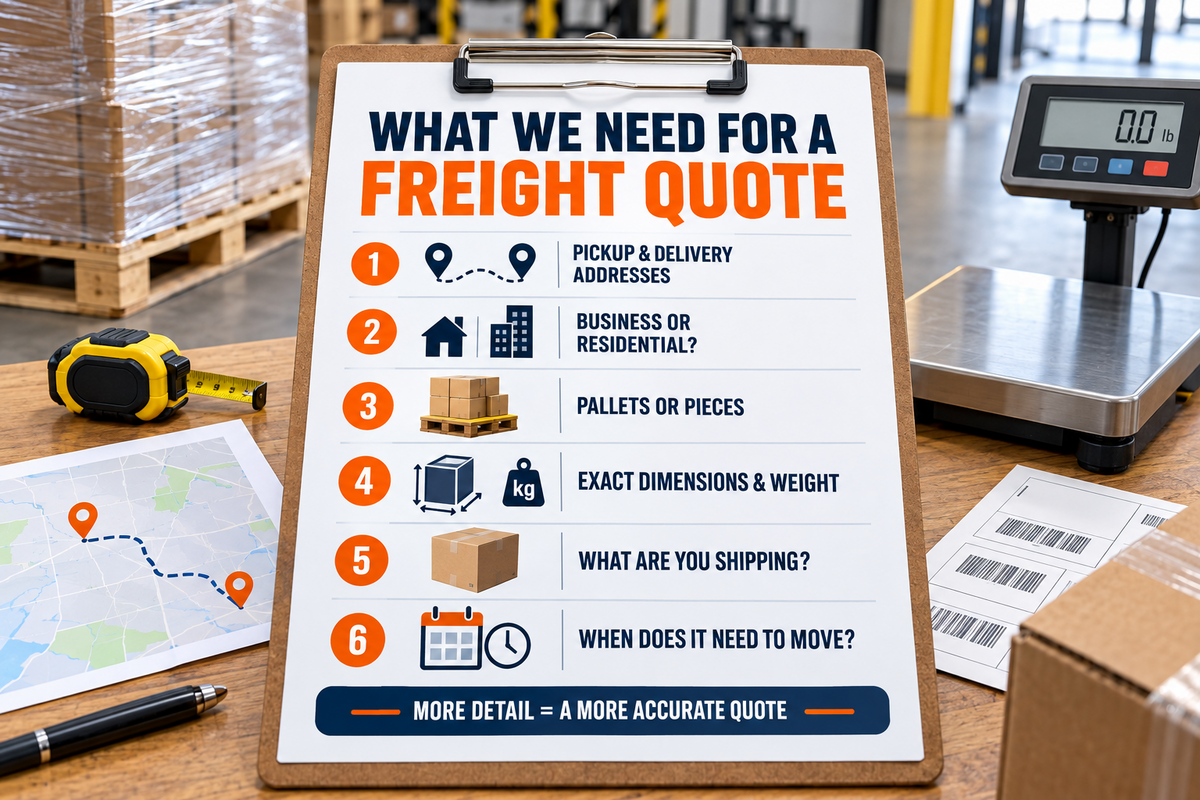
Measure the shipment after it is wrapped, strapped, crated, or otherwise ready to move. Use the outermost points. If a crate is wider than the equipment inside it, the carrier needs the crate dimensions. If the pallet and packaging add weight, include them.
More detail means a more accurate quote.
Why freight does not always have an instant online price
Freight pricing is built from several connected details. Weight and dimensions matter, but so do freight class, origin, destination, commercial or residential access, available equipment, and requested delivery services.
Carrier availability can also vary by shipment and route. DH Solutions coordinates with a freight carrier network and reviews the details before providing a quote. We typically respond within one business day. If you need help sooner, call us at 256.800.6844.
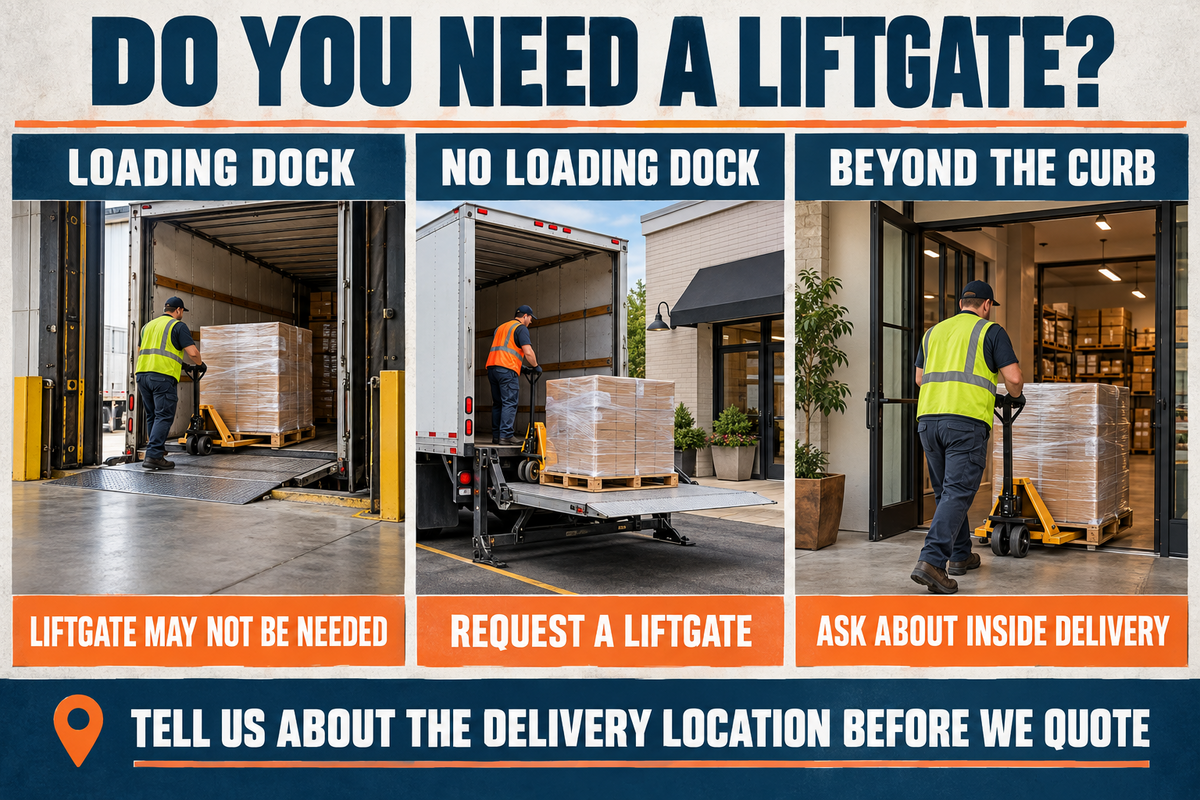
Do you need a liftgate?
A loading dock is built at trailer height so freight can move between the building and trailer. Many residences and small businesses do not have one. In that situation, a liftgate can raise or lower the pallet between the trailer and ground level.
Tell us if either location lacks a loading dock or forklift. A liftgate is a service option that affects the carrier selection and price, so it should be included in the quote instead of discovered when the driver arrives.
Inside delivery is different. A liftgate gets freight to ground level. Inside delivery asks the carrier to move it beyond the normal curbside or loading area, subject to the location and service terms. If you need either service, mention it before the quote is prepared.
Can freight be delivered to a residence?
Yes. DH Solutions can arrange residential as well as commercial freight delivery. The residential designation matters because the carrier must plan for the location. A home may have a narrow road, limited turning space, a gate, stairs, or no equipment for unloading.
Describe the site honestly and specifically. Do not list a residence as a business simply because someone works from home. Correct location information helps prevent delays and unexpected service changes.
What about hazardous materials?
Tell us exactly what you are shipping. Some materials need special documentation, packaging, labeling, or handling. Some may not be eligible for standard freight service.
Do not rely on a general description such as “supplies,” “parts,” or “equipment” if the shipment includes batteries, chemicals, compressed gas, fuel, or another regulated material. DH Solutions will confirm what is possible after reviewing the commodity.
Seven freight quote mistakes to avoid
1. Measuring only the product
The carrier needs the final pallet or crate dimensions, including anything that extends past the base.
2. Forgetting packaging weight
The pallet, crate, protective materials, and attachments count toward the total shipment weight.
3. Using a vague commodity description
“Machine parts” is less useful than a specific description of the material, use, packaging, and condition.
4. Leaving out the delivery environment
A business name does not guarantee a loading dock. Say what equipment and access the location actually has.
5. Requesting a liftgate after booking
Tell us before the quote if ground level service is needed at pickup or delivery.
6. Hiding unusual or regulated contents
Accurate disclosure protects the shipment, the carrier, and everyone handling it.
7. Building an unstable pallet
Loose cartons, weak pallets, top heavy loads, and unsupported overhang make freight harder to handle and more vulnerable to damage.
A simple path from “How do I ship this?” to a freight quote
Start with three things: the fully prepared size, the fully prepared weight, and a precise description of the contents. Then describe the pickup and delivery locations, including whether they are residential or commercial and whether a dock, forklift, liftgate, or inside delivery is needed.
You do not have to sort out every detail alone. DH Solutions helps Huntsville customers arrange palletized LTL freight, oversized shipments, and heavy items that have outgrown normal parcel service. We can also help with freight class and packaging questions and coordinate the shipment through our freight carrier network.
Ready to find out whether your shipment should move as freight? Visit our freight shipping page, call 256.800.6844, or contact DH Solutions with your shipment details.
DH Solutions is located at 7900 Bailey Cove Road SE, Suite 8A, Huntsville, Alabama 35802.
Frequently asked questions
What counts as freight?
Freight commonly includes palletized shipments, items over about 150 pounds, or oversized pieces that do not fit standard parcel limits. Size, shape, packaging, and handling needs also matter. If you are unsure, describe the complete shipment to DH Solutions.
What is LTL freight shipping?
LTL means less than truckload. The shipment uses part of a freight trailer instead of requiring an entire truck, making it a practical option for many pallets, heavy items, and oversized shipments.
What information is needed for a freight quote?
Provide the pickup and delivery addresses, whether each location is a business or residence, the number of pallets or pieces, exact dimensions and weight, what is being shipped, and how soon it needs to move. Also mention docks, forklifts, liftgates, inside delivery, and access restrictions.
Does DH Solutions offer liftgate and inside delivery options?
Yes. Liftgate and inside delivery are common freight service options. Tell DH Solutions what is needed before the quote because these services affect the price and carrier arrangements.
How long does a freight quote take?
DH Solutions typically responds within one business day. Call 256.800.6844 if you need help sooner.
Can freight be delivered to a residence?
Yes. Residential pickup and delivery can be arranged. The quote should identify the location as residential and include any required liftgate or access details.
Can DH Solutions ship hazardous materials?
Eligibility depends on the exact material. Some shipments require special handling or are not eligible for standard freight service. Disclose the contents so DH Solutions can confirm what is possible.
Can DH Solutions help with freight class and packaging?
Yes. DH Solutions can help customers work through freight class information and packaging considerations before arranging the shipment.