

How to Pack and Ship Fragile Items Safely
A fragile sticker cannot protect what is moving inside the box. Learn how to choose the right box, cushion every side, stop movement, double box when necessary, and test the package before shipping.
The worst time to discover that a package was not packed well is when the person receiving it hears pieces moving inside the box.
Maybe it is your grandmother's serving dish, a framed photograph, a handmade ceramic piece, or a birthday gift that cannot simply be replaced. You can write FRAGILE in enormous letters on the outside, but the real protection has to happen inside.
The basic method is straightforward: use a strong box, wrap each item separately, cushion it on every side, prevent movement, seal every opening with shipping tape, and double box items that need extra protection.
Here is how to do each step properly.
Start with the item, not the box
Before choosing a box, look closely at what you are shipping.
Ask yourself:
- Where is it most likely to crack, bend, or puncture?
- Does it have handles, corners, a screen, or a narrow stem?
- Are several breakable pieces traveling together?
- Is the item heavy enough to crush weak cushioning?
- Would damage be inconvenient, expensive, or impossible to fix?
A ceramic mug needs protection around its handle and empty center. A picture frame needs support across its face and extra protection at the corners. A glass set needs every piece wrapped individually so the glasses cannot strike one another.
This quick inspection tells you where the package needs more support before you use a single piece of tape.
Step 1: Choose a strong box with room for cushioning
The right box is larger than the item, but not dramatically larger. You need enough space to protect every side without creating a cavern that must be filled with unnecessary material.
Use a clean corrugated shipping box with all flaps intact. A reused box may be acceptable when it is still rigid and undamaged, but soft corners, creases, tears, moisture damage, or an old shipping history are warnings that it has lost strength.
Also remove or completely cover old addresses, barcodes, and hazardous material markings. An old label can confuse automated sorting or make the package appear to contain something it no longer carries.
Step 2: Wrap every fragile piece separately
If several items share a box, do not wrap them as one bundle. Each piece needs its own protective layer.
Bubble cushioning works well for many lightweight breakables because it protects surfaces and absorbs impact. Start at the most vulnerable areas, then wrap the entire item in multiple layers. Secure the wrap to itself without placing tape directly on a delicate finish.
Pay special attention to:
- Handles and stems
- Sharp corners and edges
- Glass faces and screens
- Lids and removable parts
- Areas where two pieces could touch
Fill hollow spaces when appropriate. A small amount of clean packing material inside a mug or vase can support the walls, but do not force material into a delicate opening.
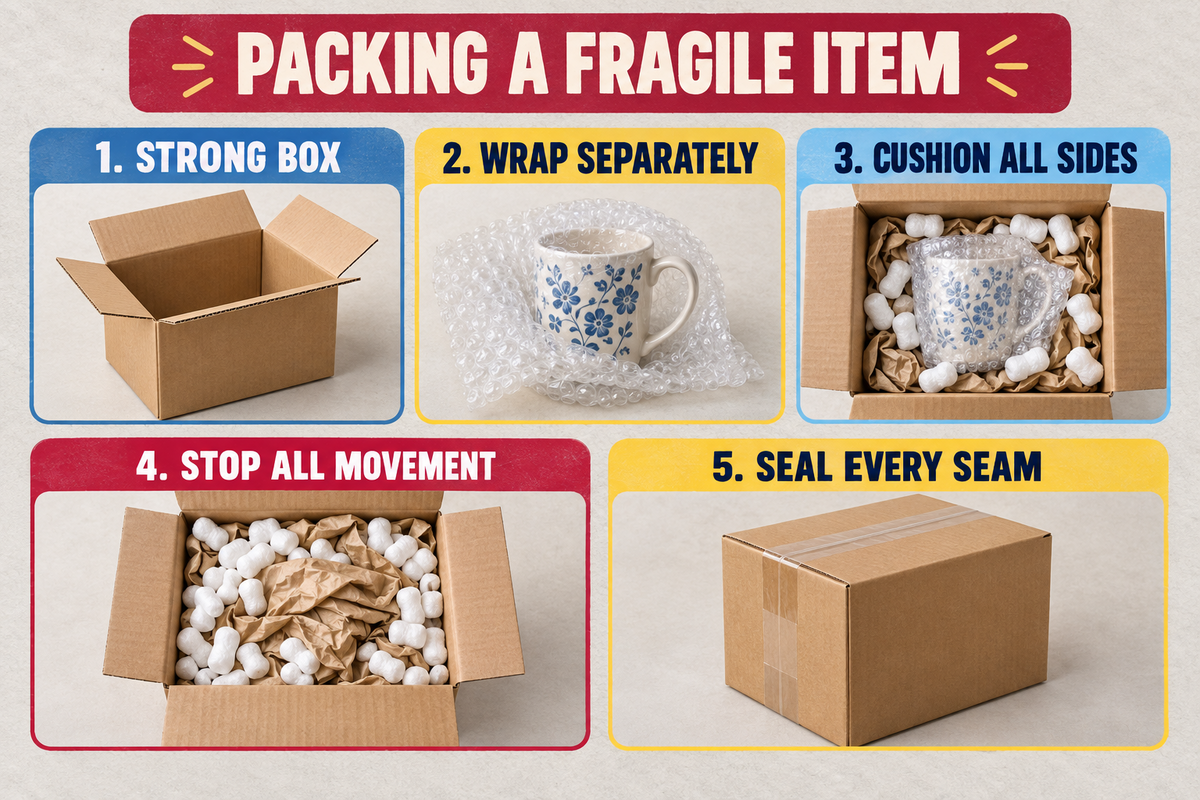
Step 3: Build a cushion beneath the item
Do not place a wrapped item directly against the bottom of the box. Start with a firm layer of appropriate cushioning.
Bubble wrap, foam, corrugated inserts, and packing peanuts can all play a role. The right choice depends on the object's weight, shape, and fragility. Packing peanuts are useful for filling empty space around many lightweight items, but they can settle during transportation. Kraft paper is useful for filling space and bracing durable objects, but loosely crumpled paper alone is not ideal protection for a very delicate or heavy item.
Carrier guidance varies by item and packing method. UPS generally recommends at least two inches of suitable cushioning for small packages, while FedEx recommends three inches of air cellular cushioning for many breakable items. Think of those numbers as starting guidance, not a universal formula. Heavy, sharp, unusually delicate, or irreplaceable objects may need a different system.
Step 4: Center the item and protect all six sides
The item should not touch the top, bottom, or any wall of the box.
Place it in the center, then fill the space around it with cushioning. That means protection on all six sides:
- Bottom
- Top
- Front
- Back
- Left
- Right
For multiple items, add enough separation that they cannot collide. Corrugated dividers or individual inner boxes may work better than simply adding more loose fill.
Do not pack a heavy object beside a light, fragile one unless both are isolated. During handling, the heavier item can shift and become the thing that causes the damage.
Step 5: Stop all movement inside the box
Before sealing the box, close the flaps and gently move it from side to side.
If you hear or feel the contents shifting, the package is not ready. Open it and add or adjust the cushioning. The goal is not to squeeze the item tightly against the cardboard. The goal is to hold it securely in the center while the cushioning absorbs movement and impact.
This simple shake test catches one of the most common packing mistakes before the package leaves your hands.
Step 6: Double box items that need more protection
Double boxing creates a second layer of protection around the first packed box. It is especially useful for highly fragile, valuable, heavy, sharp, or irreplaceable items.
To double box:
- Pack and seal the item securely inside the first box.
- Choose a sturdy outer box with room for cushioning around the inner box.
- Add cushioning to the bottom of the outer box.
- Center the inner box.
- Cushion every side so the inner box cannot touch the outer walls or move.
- Close and test the outer box before sealing it.
Both UPS and FedEx publish box-in-box methods for fragile goods. Their current guidance calls for roughly three inches of cushioning around the inner box in that setup. The actual material and construction should still match the item's weight and vulnerability.
Step 7: Seal the box using the H-tape method
Use strong tape intended for shipping. Masking tape, gift-wrapping tape, and string are not designed to hold a shipping carton closed through normal handling.
For the H-tape method, tape the center seam where the flaps meet, then tape the two edge seams. Repeat the pattern on the bottom when needed. From above, the three strips form the letter H.
Do not use tape to compensate for a damaged or weak box. If the cardboard is failing, change the box.

Step 8: Place the label on a broad, flat surface
Put the shipping label on the largest flat surface of the box. Keep it away from corners, edges, and taped seams. Make sure the barcode is flat and unobstructed.
It is also wise to place a duplicate address and phone number inside the box in case the outer label is damaged or separated.
A fragile label may alert handlers to the nature of the contents, but it is not a substitute for proper packing. Build the package as though it will travel through conveyor systems, vehicles, sorting equipment, and ordinary stacking with other boxes.
Common fragile-packing mistakes
Choosing a box that barely fits
If the item is touching the cardboard, there is no protective zone to absorb impact.
Leaving too much empty space
An oversized box can allow the contents to build momentum before striking the side. It can also increase dimensional shipping weight.
Wrapping several breakables together
Items can damage one another even when the outside of the bundle looks protected.
Depending only on loose fill
Packing peanuts and paper can fill space, but a delicate item usually needs direct wrapping and proper positioning too.
Using a tired box
A box with crushed corners, weak seams, or moisture damage may fail even when the inside looks carefully packed.
Assuming insurance replaces good packing
Shipment protection and declared value do not make poor packaging acceptable. Coverage and claims remain subject to carrier terms, documentation, and packaging requirements.
When should you let a professional pack it?
Packing it yourself may be reasonable when the item is easy to replace, simple in shape, and well matched to materials you already have.
Professional packing deserves serious consideration when the item is:
- Sentimental or irreplaceable
- Fragile and expensive
- Heavy, sharp, or unusually shaped
- A framed picture, artwork, antique, electronic device, or instrument
- Traveling internationally
- Difficult to insure when self-packed
- Something you are simply not confident packing
DH Solutions offers professional packing in Huntsville, AL using regular, proven materials such as sturdy boxes, bubble wrap, foam, packing peanuts, and double boxing where appropriate. The store maintains more than 20 box sizes, and items professionally packed by the team are guaranteed for insurability, subject to applicable carrier and coverage terms.
If you want the item packed and shipped in one visit, bring it to 7900 Bailey Cove Road SE, Suite 8A, Huntsville, AL 35802. You can also call 256.800.6844 before bringing in something large, unusually shaped, or especially delicate.
Get a packing and shipping quote
You do not need to guess the final box size before asking for help. Use the DH Solutions shipping quote form and describe:
- What the item is
- Its approximate size and weight
- Where it is going
- Whether it is fragile, valuable, or already packed
- When you would like it to arrive
If the item needs professional packing, say so in the request. The team can account for the finished package when reviewing your shipping options.
The safest package is not the one with the most material stuffed inside. It is the one where the box, cushioning, item, tape, and shipping plan all work together.
Frequently asked questions
What is the best material for packing fragile items?
There is no single best material for every object. Bubble cushioning works well for wrapping many lightweight breakables. Foam and corrugated inserts can provide stronger support. Packing peanuts and tightly crumpled kraft paper can fill empty spaces in appropriate packages. The item's weight, shape, surface, and weak points should determine the combination.
How much bubble wrap should I use for a fragile item?
FedEx currently recommends at least three inches of air cellular cushioning around many fragile products. UPS generally recommends at least two inches of appropriate cushioning for small packages and additional cushioning for box-in-box packing. Treat those measurements as general guidance because some items require specialized protection.
Should fragile items be double boxed?
Double boxing is recommended for many highly fragile, sharp, valuable, or difficult-to-replace items. The inner box is fully packed and sealed, then suspended within a larger outer box using cushioning on every side.
Can two fragile items go in the same box?
Yes, if each item is wrapped separately and the items are divided or cushioned so they cannot strike each other. Do not allow a heavy item to move toward a lighter breakable object.
Does writing “fragile” on a box protect it?
A fragile label may communicate that the contents need care, but it does not replace a strong box, individual wrapping, adequate cushioning, movement control, and secure sealing.
Can DH Solutions pack an item that I have already boxed?
Yes. Bring the box in before final shipment. The team may need to inspect the package or reopen it to confirm that the item and materials meet applicable carrier requirements.